Reading a red-brick museum front
- Words
- Amara Lind
- Published
Arches, small domes and a great deal of red brick: how to read a historic civic facade from the pavement, one layer at a time.
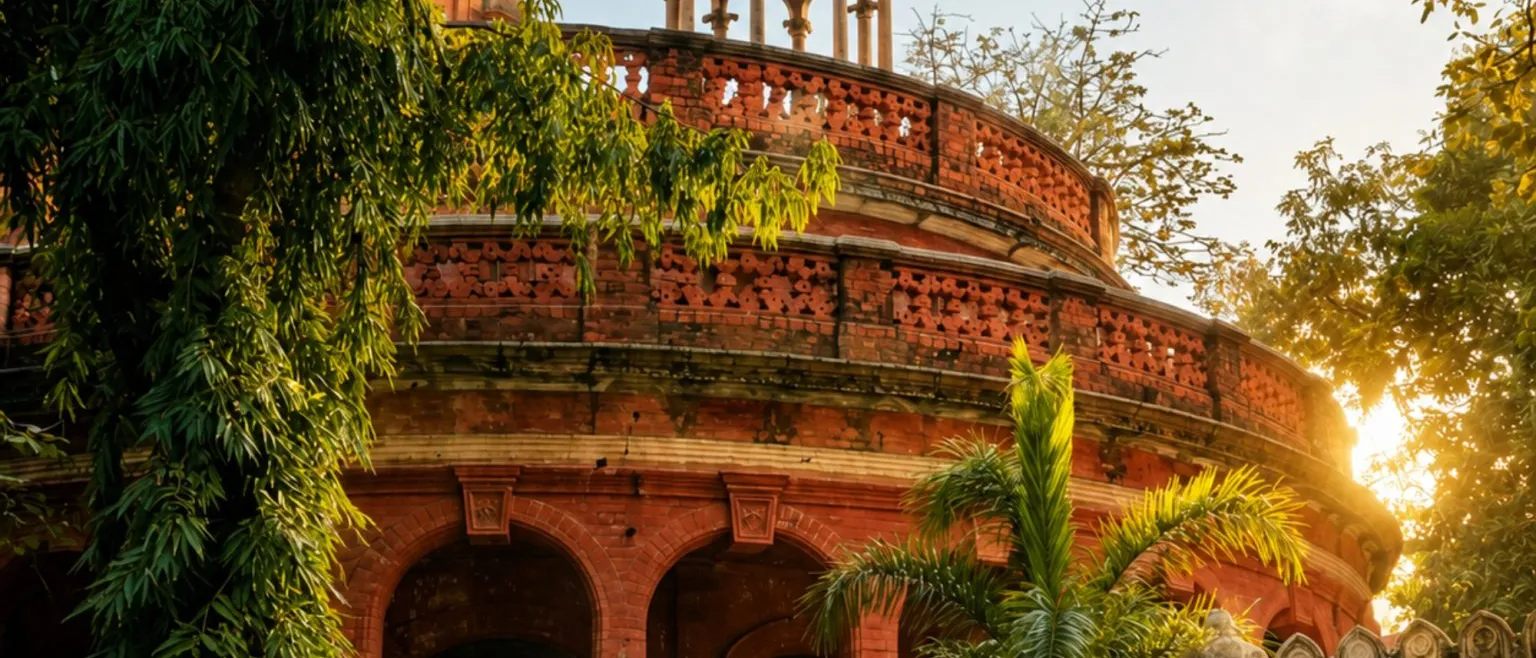
Some buildings are easiest to understand from across the road. This museum front is one: a long wall of red brick broken by arches and topped with domes and turrets, in the Indo-Saracenic style that mixed Indian, Islamic and European forms in many public buildings of the late nineteenth and early twentieth centuries.
Start with the rhythm
Before the details, count the openings. Arches repeat along the facade at a steady interval, and the eye uses them as a ruler. Anything that breaks the rhythm, a wider entrance or a projecting bay, is where the building wants attention.
Then the roofline
Domes and small pavilions along the top are the facade’s punctuation. They mark corners and entrances, and they make a long building legible from a distance, which mattered when it had to announce itself across an open street.
- Brick colour: patches of a slightly different red usually show where repairs have been made.
- Light trim: pale bands of stone or plaster tend to mark floor levels and the heads of windows.
- Shade: deep arches keep walls and walkways cool, which is as much about climate as style.
Before the details, count the openings. The arches are a ruler.
None of this needs a guidebook. It needs ten minutes on the opposite pavement, and the patience to look at the whole front before any one part of it.